Posts

Showing posts with the label Guest Blog Post

Computational Thinking - Guest Blog Post with @DrChips_
Image
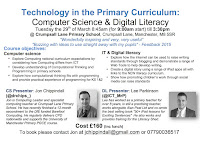
I am privileged to work alongside some amazing trainers! I will be leading conferences with Alan Peat, John Murray and Mark Anderson throughout this academic year. To find out more about these conferences, click here.  Another trainer I work alongside is Jon Chippendall aka  @DrChips_ , I have led training with Jon before however until Tuesday had never sat through his whole session. I have to say I was blown away. I feel my training focusing more on ICT and Digital Literacy, whereas, Jon focuses on Computer Science. His expert knowledge and ability to explain concepts in a way that makes any teacher understand the importance of computer science makes the day really valuable for teachers. As both myself and Jon still work in our school, we share real and successful ideas to ensure technology is being taught creatively in the classroom. I was really impressed with Jon's session on Computational Thinking. I am pleased he has been willing to write this guest blog post explainin...

2015 - A Review of the Blog

Image
Happy New Year! I hope everyone has had a lovely and restful break! 2015 was an unbelievable year for me and the blog. We passed a million visits to the blog and I published two books - 50+ iPad lessons for Exciting Sentences and 50+ iPad lessons for Non-Fiction  alongside Alan Peat . With a few more books in the pipeline and conferences running all over the country , 2016 should be another cracking year! In this blog post, I thought I would reflect on some of the lesson ideas and posts from 2015 that I really enjoyed doing in class but was also most popular with you guys! So here are my top 5 posts of 2015 - 5 - Numeracy SATs Revision guides from @GHammondMaths This blog was a guest post from  @GHammondMaths , who created a valuable resource for teachers in the build up to SATs. He created interactive practise papers where each question linked to a YouTube video that explained clearly the method to solve the question! The post has had over 6000 views and it won't...

Dr Chips' Whole School Computing Scheme of Work!

Image
"So many ideas I want to get started straight away!" "So much to take back to class, thanks so much." "Fantastic, thank you for all the great fun ideas." "Fantastic inspirational glimpse into how to engage pupils with digital literacy." "Fabulous and intriguing!" "You made something scary feel very doable." I have some very exciting news, make sure you read to the end! Today I led a course alongside Jon Chippendall aka DrChips_ focusing on the computing curriculum and how to effectively deliver it in the classroom. The course is perfect for computing leaders, class teachers and SLT looking for innovative ways to teach computing. I focus on ICT and Digital Literacy while Jon looks at the computer science aspect of the curriculum. What I love about the day is that both myself and Jon are still working in our schools so using these ideas day in day out. I am always asked about which scheme of work I would recommend for compu...

DREAM TEAM 2016 - Guest blog post from the Royal Shakespeare Company!

Image
As technology permeates more and more areas of all our lives, growing numbers of children and young people are getting their ‘first encounter’ of the arts and live theatre through ICT and online platforms.  Whilst these changes to how we consume culture present significant challenges to the cultural sector (rights being just one example) the opportunities are so great, we need to adapt quickly in order to reap the rewards writes Jacqui O’Hanlon, Director of Education at the Royal Shakespeare Company. The way we communicate, socialise and live our lives has altered dramatically over the past decade. Theatre and the arts are no exception and using an interface that young people are familiar with and feel comfortable using has helped us reach new audiences on a scale that was previously unimaginable. Digital platforms mean that we can now reach all sorts of people that we wouldn’t have been able to connect with through more traditional channels –whether because of financial or g...

Kids: Take Your Daily Maths Vidamins! Guest Blog by @ghammondmaths

Image
Here is another fantastic idea from  @ghammondmaths , if you haven't already seen his previous work linked to Maths SATs revision guides please follow this link. Kids: Take Your Daily Maths Vidamins! Whether you are a teacher or a parent, you will always be concerned about your childrens’ maths “health”. Do they have a healthy appetite for maths? Are they improving, growing and exercising their mathematical brains regularly? Along with their 5-a-day fruit + vegetables, why not provide them with their 1-a-day maths Vidamin? These Vidamins (mini-videos) aim to build strength and fluency across different topics by providing a daily, short (5 minute) maths exercise and video solution.  This is a colourful and child-friendly PDF file containing hundreds of hyperlinks to Youtube videos on @ghammondmaths ’ Youtube Channel. In fact, there is one different Vidamin for every day of the year! The links could be used by teachers as daily starters in maths lessons or the f...

Poetry In The New Curriculum- Guest Blog by Ian Bland, Children’s Poet and Performer

Image
Before the new curriculum, poetry it seems had played a bit part in primary literacy lessons. Perceived as the poor relation, poetry was that genre of writing that always seemed to be reluctantly taught for a couple of weeks of the year and then quietly ushered away as if it wasn’t quite important enough. Old guidelines required teachers to teach very specific aspects of it in definitive year groups leaving them without much freedom to cater for the children in their classes. In the new curriculum however, all of this has now changed and changed for the better! ”Memorising and reciting are prevalent in all parts of the new National Curriculum, with poetry taking centre stage in English. From year one onwards children will have to learn and recite poems by heart while recognising and discussing different poetic forms.” Curriculum Vital Poetry is now an important and central pillar of the new literacy curriculum in England and Wales. Teachers have been given the freedom to explo...

Teaching Spelling through Mary Poppins - By John Murray

Image
This blog post is a taste of what will be shared on my conference with John Murray - Improving Reading and Writing through Popular Children's Movies and Media on Friday 19th June in Dudley. Places are still available so click the link to book a place. Let’s face it, the teaching and learning of spelling can be a little formulaic and is not always the most interesting of lessons to deliver. So here’s a fun way to encourage children to talk about spelling patterns, share strategies for learning how to spell and explore reasons why people make mistakes when writing unfamiliar words. What’s more, it can also help introduce your class to the classic Mary Poppins! Ask your class: “What do you do when you think of a word you want to write down but you are not sure how to spell it?” Elicit from your class which strategies they like to use, encouraging learners to share specific examples. Include one or two words that you (as their teacher and adult) find difficult to spell yourse...

Guest Blog Post - Using Maps and Vidra To Learn About Contrasting Localities in Geography by Bryn Goodman

Image
The new Computing Curriculum for KS2 talks about ‘selecting and combining a variety of software (including internet services) to design and create a range of content’ . I decided to combine the Maps app with a presentation app called Vidra. A mini-project I completed with Year 6 helped to cover this. Our school has many international links with partner schools all over the world. One of those links is with a school in Australia. This led to our Year 6 staff deciding to plan work in Geography using Australia as a contrasting locality. As part of this work, I decided to use a feature of the Maps app that comes with every iPad (not to be confused with Google Maps which has lots of other great uses).  Many of the major cities of the world have flyover tours built into the Maps app. Wherever there is a 3D symbol next to a city, you are able to take a flyover tour of that city. The tour shows you all the major landmarks in that city in a way that makes you feel like you are fly...

Guest Blog Post - Bringing Wildlife Conservation into the Classroom by Matthew Payne

Image
Despite my advancing years, I can still remember spending pretty much every waking hour of my childhood with my head firmly stuck in a Wildlife Encyclopaedia, or glued to the television set watching the film ‘Born Free’ on repeat – much to the annoyance of my brother and sister! Instead of spending time with friends, I spent my time copying out line after line of animal facts and adding them to my own fact-files! As you can imagine – I was a very cool kid with lots of friends – if only! This never deterred me though, and since then, my love for animals has continued to blossom! I have also been fortunate enough to travel the world and see some of the animals I spent my childhood reading about. A coalition of male lions in Kenya (Source: M Payne) In addition to travelling, I now spend the majority of my spare time educating young people about wild animals and their conservation! I am extremely proud to be a Trustee of the world renowned lion conservation charity – LionAi...